ACM Transactions on Graphics · July 2026
Mixwell: Sharp 2D Fluid Brushes for Progressive Physics-Based Mixing
- SIGGRAPH 2026 Best Paper
- ACM Transactions on Graphics
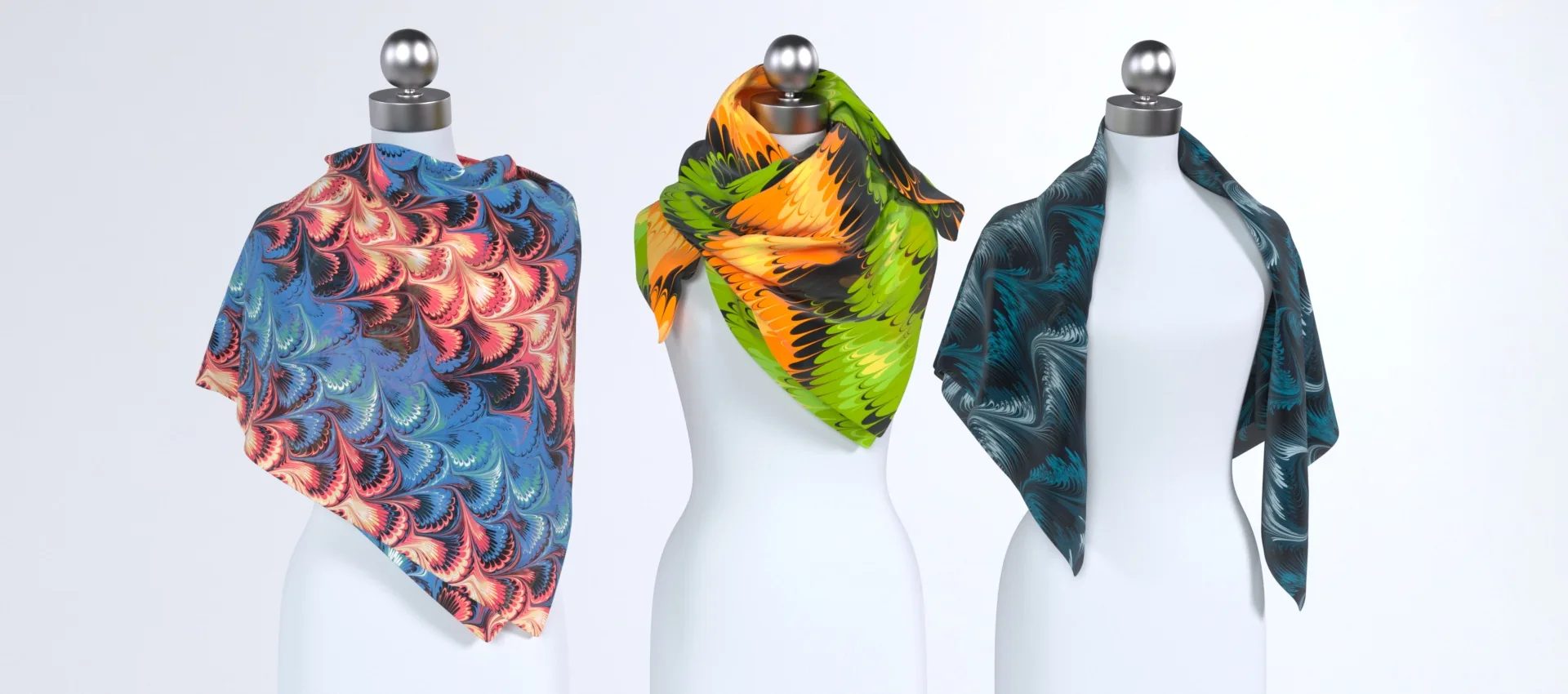 ⤢ Explore the full 16K render
Abstract
We present Mixwell, a family of sharp 2D fluid brushes and GPU-accelerated analytical methods for progressive, resolution-independent physics-based mixing. Derived from idealized potential flow around a cylindrical tine, Mixwell includes a cusped, Kelvinlet-style regularized velocity brush that parsimoniously captures cylinder-fluid interactions. Building on Maxwell's 1869 drift formulation, we develop GPU-friendly evaluation strategies for particle drift in both infinite and finite strokes. For image-based workflows, we introduce cylindrical Reverse-Drift Functions (RDFs), displacement fields that encode tine insertion, motion, and removal. Like signed distance fields in geometric modeling, RDFs compose naturally and can be chained in shaders to model complex operations while avoiding intermediate texture blur. We also propose a periodicity-exploiting composition scheme for complex RDF patterns. All Mixwell operations are evaluated independently per sample, enabling truly progressive mixing and rendering without global solves, grids, or intermediate texture resampling. We demonstrate real-time GLSL and HLSL implementations and production integrations in Houdini (OpenCL, OSL), enabling progressive, arbitrary-resolution mixing and rendering with negligible numerical dissipation.
 Graphics Replicability Stamp
BibTeX
@article{10.1145/3811312,
author = {James, Doug and James, Ethan},
title = {Mixwell: Sharp 2D Fluid Brushes for Progressive Physics-Based Mixing},
year = {2026},
issue_date = {July 2026},
publisher = {Association for Computing Machinery},
address = {New York, NY, USA},
volume = {45},
number = {4},
issn = {0730-0301},
url = {https://dl.acm.org/doi/10.1145/3811312},
doi = {10.1145/3811312},
abstract = {We present Mixwell, a family of sharp 2D fluid brushes and GPU-accelerated analytical methods for progressive, resolution-independent physics-based mixing. Derived from idealized potential flow around a cylindrical tine, Mixwell includes a cusped, Kelvinlet-style regularized velocity brush that parsimoniously captures cylinder-fluid interactions. Building on Maxwell's 1869 drift formulation, we develop GPU-friendly evaluation strategies for particle drift in both infinite and finite strokes. For image-based workflows, we introduce cylindrical Reverse-Drift Functions (RDFs), displacement fields that encode tine insertion, motion, and removal. Like signed distance fields in geometric modeling, RDFs compose naturally and can be chained in shaders to model complex operations while avoiding intermediate texture blur. We also propose a periodicity-exploiting composition scheme for complex RDF patterns. All Mixwell operations are evaluated independently per sample, enabling truly progressive mixing and rendering without global solves, grids, or intermediate texture resampling. We demonstrate real-time GLSL and HLSL implementations and production integrations in Houdini (OpenCL, OSL), enabling progressive, arbitrary-resolution mixing and rendering with negligible numerical dissipation.},
journal = {ACM Trans. Graph.},
month = jul,
articleno = {79},
numpages = {18}
}
Explore Demos and Code
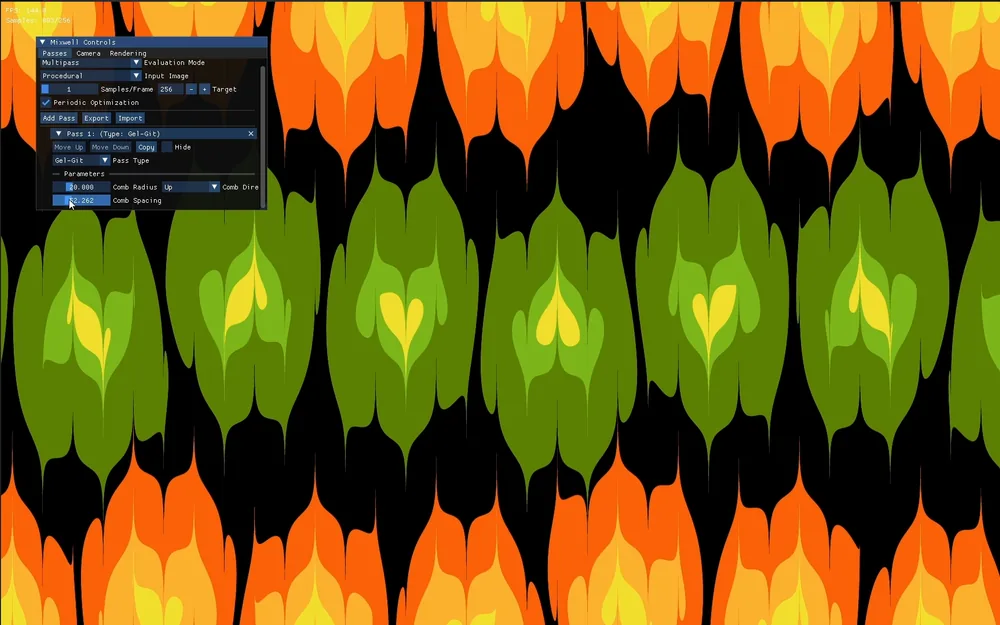
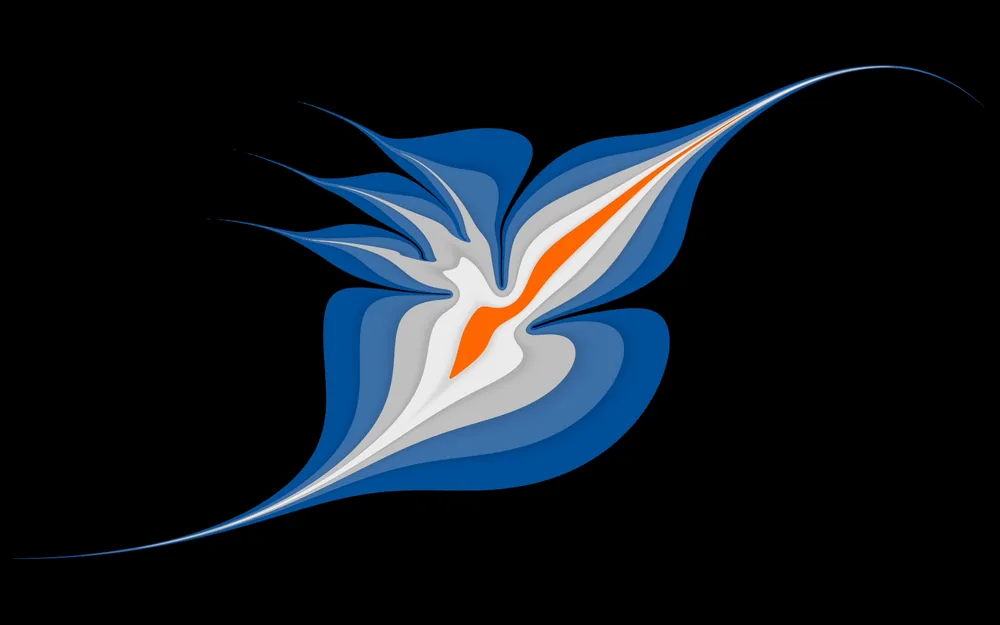
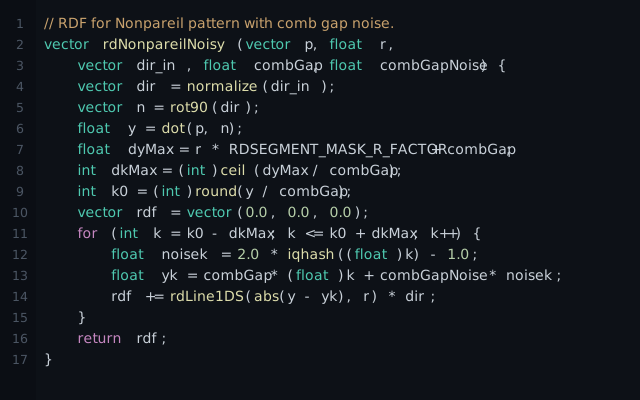
News
- Mixwell received the Graphics Replicability Stamp for its released code and demos.
- Photos from the SIGGRAPH 2026 presentation and Best Paper award.
- Shader gallery updated with new Shadertoy examples.
- Presented at SIGGRAPH 2026 in the Phased & Viscous Fluids session.
- LinkedIn post about the SIGGRAPH 2026 talk.
- Project site launched with demos, shader gallery, and code libraries.
- Mixwell published in ACM Transactions on Graphics 45(4).
- Mixwell selected as a Best Paper at SIGGRAPH 2026.